
The Paradox
This framework has nothing and everything to do with actual golf.
Nothing
You don't need to know golf. You don't need to play golf. The framework doesn't require understanding of course layouts, club selection, or scoring rules. The golf terminology is a scaffold—a familiar structure to hang complex ideas upon.
Everything
Golf embodies practices that transfer directly to AI development: reading terrain, choosing strategy by context, managing variance, converging through iteration, maintaining patience and precision. The meditative aspects of golf—its ritual, its pacing, its acceptance of imperfection—map perfectly to working with LLMs.
The Three-Domain Ontology
Three domains—Golf, Mathematics, and LLM Development—intertwine to form a coherent framework for understanding and navigating semantic space.
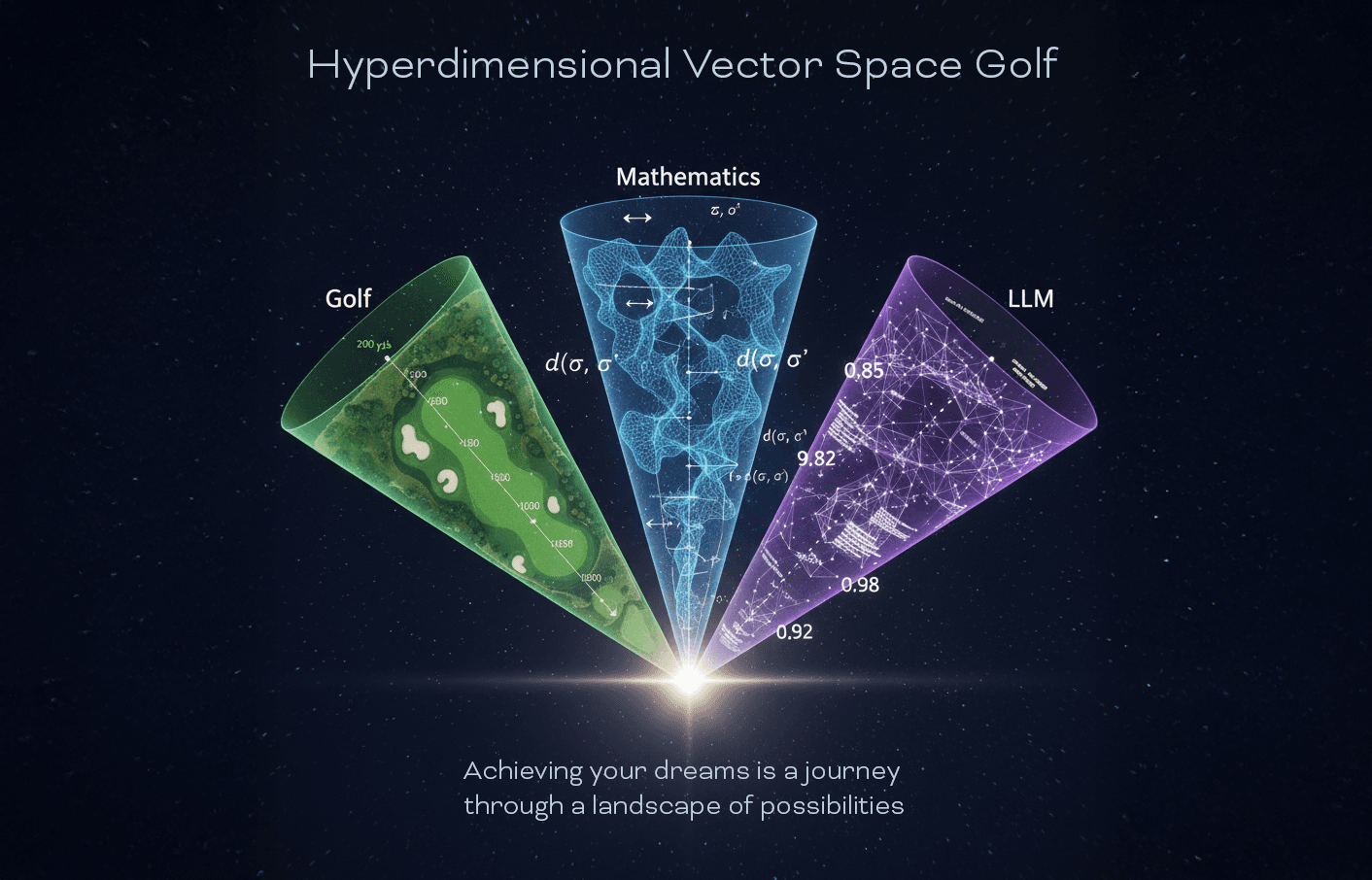
Golf
Intuitive Metaphor
Provides spatial narrative, pacing, and meditative practices. Golf offers an accessible vocabulary for complex concepts: terrain types, shot selection, course management, convergence toward goals.
Core Units
- • Course · Hole · Shot
- • Club · Terrain Zone
- • Par · Scorecard
Mathematics
Formal Structure
Captures formal structure and transformation logic. Manifolds, metrics, gradients, and category theory provide the mathematical substrate that makes the framework rigorous and composable.
Core Units
- • Manifold · Epsilon Ball
- • Gradient Flow · Metric
- • Category Morphism
LLM Development
Implementation Practice
Grounds implementation tactics and agent behavior. Prompt patterns, constraint profiles, iteration cadence, and review rituals operationalize the framework in real development workflows.
Core Units
- • Prompt Pattern
- • Constraint Profile
- • Iteration Cadence
Meditative Strategy: How Golf Practices Transfer to AI Development
Golf is not just a sport—it's a meditative practice. These practices transfer directly to working with AI assistants, providing structure, patience, and wisdom for navigating semantic space.
Reading Terrain
In Golf: Before each shot, a golfer reads the terrain—wind, slope, hazards, green conditions. This assessment determines strategy.
In AI Development: Before each prompt, assess the semantic terrain. Is the goal clear (green)? Are requirements vague (rough)? Is the solution space well-mapped (fairway)? This assessment determines prompt strategy—exploratory (driver) or precise (putter).
Club Selection by Context
In Golf: You don't use a driver on the green. You don't use a putter from the tee. Each club serves a purpose based on distance, terrain, and precision needs.
In AI Development: Match prompt precision to semantic distance. Broad exploratory prompts (drivers) for early exploration. Narrow, constrained prompts (putters) when close to solution. The wrong "club" wastes iterations and creates frustration.
Patience and Acceptance
In Golf: Golf teaches patience. Not every shot is perfect. You accept bad shots, learn from them, and move forward. The game rewards persistence over perfectionism.
In AI Development: LLM outputs aren't always perfect. Accept imperfect responses, refine through iteration, and maintain patience. The framework rewards persistence and iterative refinement over expecting perfect first attempts.
Course Management
In Golf: Smart golfers manage the course strategically. They don't always go for the pin. Sometimes they play safe, position for the next shot, and think multiple shots ahead.
In AI Development: Manage the development trajectory strategically. Don't always optimize for immediate perfection. Sometimes accept "good enough" to maintain momentum, position for the next iteration, and think about the overall trajectory toward the goal.
Convergence Through Iteration
In Golf: You don't reach the hole in one shot. You converge through a sequence: drive, approach, chip, putt. Each shot narrows the distance and increases precision.
In AI Development: You don't solve complex problems in one prompt. You converge through a sequence: exploratory prompt (drive), directional refinement (approach), specific implementation (chip), final polish (putt). Each iteration narrows semantic distance and increases precision.
Find Your Path
The framework adapts to your level. Start where you're comfortable, and progress as understanding deepens.
Beginner
Visual Metaphor
Start with intuitive golf metaphors. Learn through familiar analogies without mathematical complexity.
Start here →Intermediate
Developer-Focused
See how this applies to LLM-assisted coding. Understand semantic space navigation and prompt strategy.
Learn more →Advanced
Mathematical Foundations
Explore manifolds, metrics, geodesics, and convergence. Understand the formal mathematical structure.
Dive deeper →Expert
Category Theory
Explore categorical formalization, functors, natural transformations, and compositional semantics.
Explore →Key Resources
Base Communications
Multi-audience presentation system. Choose your level (Beginner to Expert) and learn the framework through audience-specific explanations.
LLM Instructions
Comprehensive guide for LLMs and humans on using the framework to structure implementation plans. Learn about 18-hole cycles and shot types.
Scorecard Dashboard
Tour the hyperdimensional scorecard with insights, trajectories, and manifold visualizations derived from live project data.
Golf Philosophy Slides
Explore the 10 shot archetypes with detailed visualizations, prompt examples, and heuristic definitions.
Diagrams
Navigate ontology-first diagrams, including semantic manifolds and the four archetype terrains.
Prototypes
Inspect interactive experiments and motif explorations inside the prototypes workspace.